

Phone:
+86-18513327189

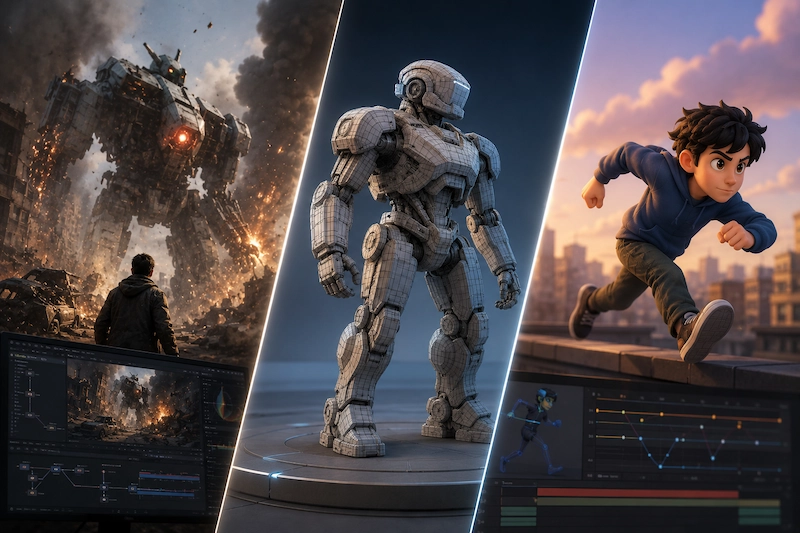
VFX design, CGI, and animation are closely related but serve distinct roles in visual production. VFX design focuses on integrating digital elements into real-world footage, CGI refers to computer-generated imagery (often fully digital assets or scenes), and animation involves creating motion from scratch, whether 2D or 3D. In practice, these disciplines often overlap, but understanding their differences is essential for choosing the right production approach.
VFX design (visual effects design) is the process of enhancing or manipulating live-action footage using digital techniques. It is primarily used in film, advertising, and branded content where real-world footage needs augmentation.
Compositing CGI elements into real footage
Creating environments that don’t exist physically
Enhancing practical effects (explosions, weather, lighting)
Removing unwanted elements (wire removal, cleanup)
In a motion graphics studio environment, VFX design is rarely standalone. It typically sits at the intersection of compositing, tracking, and rendering pipelines. Tools like compositing software and 3D engines are combined to ensure seamless integration between reality and digital assets.
CGI refers to any visual content created entirely using computer software, without relying on real-world footage as a base.
Fully animated films and sequences
Product visualization and commercials
Architectural rendering
Game cinematics
Entire scenes can be digitally created
No dependency on live-action footage
High control over lighting, physics, and materials
CGI is often misunderstood as being synonymous with VFX. In reality, CGI is a toolset, while VFX design is an application context. For example, a 3D-rendered explosion is CGI, but placing it into a filmed scene is part of VFX design.
Animation is the art of creating motion and storytelling through sequential images, either in 2D or 3D formats.
2D animation (motion graphics, explainer videos)
3D animation (character animation, product demos)
Stop-motion animation
Unlike VFX design, animation:
Does not require live-action footage
Focuses on movement, timing, and storytelling
Often builds entire scenes from scratch
For motion graphics companies, animation is often the core service offering, especially in branding, advertising, and digital campaigns. VFX design is typically used when animation needs to blend with real-world footage.
| Aspect | VFX Design | CGI | Animation |
|---|---|---|---|
| Primary Purpose | Enhance live-action footage | Create digital visuals | Create motion and storytelling |
| Dependency on Real Footage | Yes | No | No |
| Typical Use Cases | Films, ads, compositing | Games, films, product renders | Explainers, films, ads |
| Core Focus | Integration | Creation | Movement |
| Workflow Complexity | High (tracking + compositing) | Medium–High | Medium–High |
In professional production pipelines, these three disciplines are rarely isolated.
Live-action footage is captured
CGI elements are created (3D models, simulations)
Animation brings those elements to life
VFX design integrates everything into the final shot
In a commercial:
A product may be modeled using CGI
Its motion and interaction are handled through animation
It is then composited into real footage using VFX design
This integrated approach is standard in high-end motion graphics studios.
You have live-action footage that needs enhancement
You want realistic integration of digital elements
You need cinematic-level compositing
Your project is fully digital
You require high control over environments and lighting
Physical shooting is impractical or impossible
You need storytelling through motion
You are creating explainer or branding content
No real-world footage is required
No. VFX design uses CGI, but they are not the same thing.
CGI is the creation process
VFX design is the integration process
Without CGI, modern VFX design would be limited. However, CGI can exist independently without VFX.
Animation can be a component within VFX design workflows, but it is not inherently the same.
For example:
Animating a 3D character → Animation
Placing that character into live footage → VFX design
Neither is inherently better—they serve different objectives.
VFX design excels in realism and integration
Animation excels in storytelling and flexibility
In commercial production, the most effective projects combine both.
AI is rapidly transforming production pipelines:
Automated rotoscoping and tracking in VFX design
Procedural generation in CGI workflows
Motion automation in animation systems
For studios, this means:
Faster turnaround times
Lower production costs
Increased scalability for content creation
However, creative direction and artistic control remain human-driven.
They are not interchangeable. CGI is a subset of tools used within VFX workflows.
Modern animation is widely used in corporate videos, product demos, and UI motion design.
VFX design is heavily used in advertising, social media content, and branded storytelling.
Understanding the distinction between VFX design, CGI, and animation is critical for making informed production decisions. VFX design focuses on integrating digital elements into reality, CGI generates those elements, and animation brings them to life.
In a professional motion graphics studio setting, these disciplines operate as a unified pipeline rather than isolated services. Choosing the right combination depends on your project’s goals, whether that’s realism, flexibility, or storytelling impact.
VFX design integrates digital elements into real footage, while CGI refers to creating those digital elements.
Yes. Traditional 2D animation does not require CGI, although modern workflows often combine both.
Yes. It is widely used for product commercials, brand storytelling, and visual enhancements.
Costs depend on complexity, but VFX design can be more resource-intensive due to compositing and tracking requirements.
Not always. However, high-end productions often combine CGI, animation, and VFX design for the best results.