
Phone:
+86-18513327189

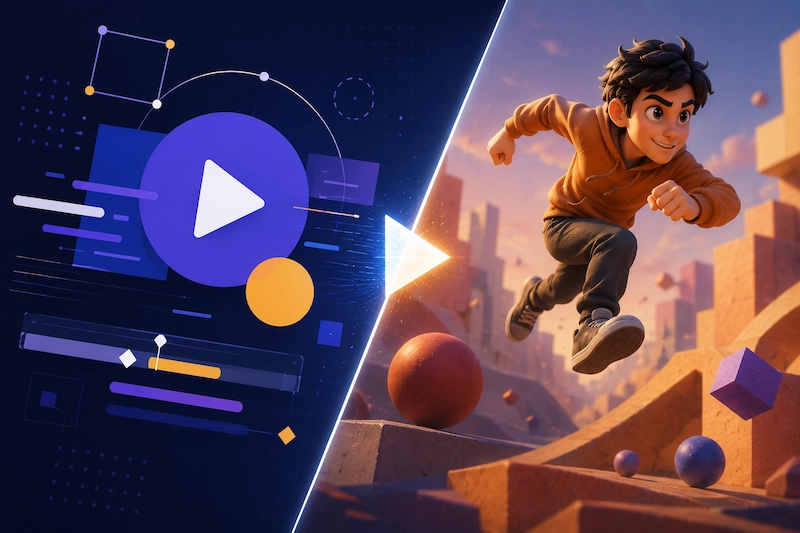
Motion graphics and animation share the same technical foundation — sequences of images played in rapid succession to create the illusion of movement. The distinction lies in purpose, content, production approach, and cost structure. If you are deciding which format to commission for your next project, the wrong choice can mean spending 2–4x more than necessary or ending up with content that does not serve your business objective.
Here is the practical breakdown.
Motion graphics animate graphic design elements — text, shapes, icons, charts, and photographs — to convey information, emphasize data, or guide viewer attention. The subject is usually abstract or informational.
Animation brings characters, narratives, and worlds to life through illustrated or modeled subjects that move, emote, and interact within a story. The subject is usually representational.
A product launch video with animated statistics, kinetic typography, and a logo reveal is motion graphics. The same product launch told through a 30-second story about a character discovering the product is animation.
| Factor | Motion Graphics | Animation |
|---|---|---|
| Primary purpose | Inform, explain, present data, brand identity | Tell stories, evoke emotion, entertain |
| Typical content | Text, charts, icons, logos, UI elements, photos | Characters, backgrounds, environments, props |
| Art style | Clean, graphic, often flat or semi-3D | Illustrative, stylized, or realistic 3D |
| Production complexity | Moderate — fewer custom assets per frame | High — custom characters, backgrounds, lip-sync |
| Typical timeline | 2–4 weeks | 4–12 weeks |
| Cost range (60-sec video) | 3,000–15,000 | 8,000–50,000+ |
| Best for | Marketing, presentations, data communication, social ads | Brand storytelling, entertainment, product demos with narrative |
| Revision flexibility | High — elements are modular and easily swapped | Lower — changes to character animation ripple through scenes |
| Accessibility | Straightforward — text-based, easy to caption | More complex — requires audio description for visual storytelling |
Motion graphics are the right choice when your primary goal is communicating information clearly and persuasively. Specific scenarios:
If your content involves statistics, processes, comparisons, or any information that benefits from visual simplification, motion graphics outperform narrative animation. Animated charts, flow diagrams, and data-driven visuals make abstract numbers tangible.
Real-world application: A SaaS company explaining its pricing tiers uses motion graphics to animate a comparison table, highlight key differences, and guide the viewer's eye through the decision framework. A character-driven animation would be slower, more expensive, and less direct.
Motion graphics production is modular. A studio can build a template system that allows rapid creation of dozens of variations — different products, regions, languages — without starting from scratch each time. Animation, with its reliance on custom character performance, does not scale as efficiently.
Real-world application: A retail brand producing 50 product videos per quarter across multiple markets uses a motion graphics template system. Each video costs800–1,500 after the initial system build. Equivalent character animation would cost3,000–6,000 per video.
Board presentations, investor updates, pitch decks, and internal training materials demand a professional visual language. Motion graphics deliver polish without the informality or entertainment connotation that character animation can carry in these settings.
If you need a polished 60-second video in under 3 weeks with a budget under $8,000, motion graphics is the practical choice. Character animation at that budget and timeline will either cut corners on quality or require significant scope reduction.
Animation becomes the better investment when your goal is emotional engagement, brand differentiation, or narrative storytelling.
Characters with personality, expressions, and relatable situations create emotional bonds that abstract graphics cannot achieve. If your content strategy depends on making viewers feel something — empathy, excitement, nostalgia — animation delivers.
Real-world application: A healthcare brand explaining a pediatric treatment uses a gentle character animation showing a child's journey from diagnosis to recovery. The emotional resonance drives sharing, recall, and trust in ways that a data-driven motion graphics piece would not.
Brands with established mascots, illustrated universes, or character-driven storytelling (think Duolingo's owl, Mailchimp's Freddie, or Headspace's characters) must invest in animation to maintain consistency. Motion graphics cannot replicate the personality of a well-designed character.
For videos longer than 2 minutes, motion graphics can feel monotonous without narrative structure. Animation with character arcs, scene transitions, and story progression sustains viewer attention over extended durations.
Gen Z and younger audiences have strong preferences for animated, character-driven content. If your primary audience skews under 35, animation often outperforms motion graphics in engagement metrics, shareability, and brand recall.
In practice, the most effective brand videos in 2026 combine both disciplines:
Animated character opens the video with a brief narrative hook (5–10 seconds)
Motion graphics deliver the core information — product features, data, pricing, testimonials
Animated transition elements maintain visual interest between information sections
Motion graphics close with a clear call-to-action and brand identity elements
This hybrid approach balances emotional engagement with informational clarity and typically falls in the8,000–25,000 range for a 60-second piece — less than full animation, more impactful than motion graphics alone.
Understanding the cost structure behind each format helps you evaluate quotes and negotiate effectively.
| Cost Component | Percentage of Budget | Notes |
|---|---|---|
| Concept and storyboard | 15–20% | Strategy, script alignment, visual direction |
| Style frames and design | 20–25% | Key visual frames that define the look |
| Animation production | 30–40% | Keyframing, easing, timing, layer management |
| Sound design and music | 10–15% | Background music, sound effects, mixing |
| Revisions and final delivery | 10–15% | Client feedback rounds, format exports |
| Cost Component | Percentage of Budget | Notes |
|---|---|---|
| Character and world design | 20–30% | Custom character sheets, background art, prop design |
| Storyboarding and animatic | 15–20% | Detailed frame-by-frame planning |
| Voiceover and dialogue | 5–10% | Professional voice talent, multiple takes |
| Animation production | 30–40% | Character rigging, lip-sync, performance animation |
| Sound design, music, and effects | 10–15% | Foley, ambient sound, scoring |
| Revisions and delivery | 5–10% | More constrained due to ripple effects |
The key difference: animation requires significant upfront investment in character and world design before any movement happens. Motion graphics can begin animation earlier in the pipeline because the visual elements (text, shapes, icons) are faster to produce.
Answer these questions in order:
1. Is the primary goal to inform or to entertain?
Inform → Motion graphics
Entertain → Animation
Both → Hybrid
2. Does the content involve data, processes, or abstract concepts?
Yes → Motion graphics (or hybrid with animated wrapper)
No → Animation
3. Do you have an established brand character or illustrated world?
Yes → Animation is expected; deviating confuses audiences
No → Either format works; let budget and timeline guide the choice
4. What is your budget for a 60-second video?
Under $5,000 → Motion graphics
$5,000–15,000 → Motion graphics or hybrid
$15,000+ → Any format; choose based on strategic fit
5. How many videos do you need over the next 12 months?
1–3 → Choose the best format per project
4–10 → Invest in a motion graphics template system
10+ → Build a motion design system with optional animated character assets
Technically yes, but it shifts the project toward the animation end of the spectrum. Simple character animations — a waving mascot, a pointing figure — can be incorporated into motion graphics without significant cost impact. Complex character performance with emotion, dialogue, and narrative will require animation-level investment regardless of what you call it.
For paid social advertising under 30 seconds, motion graphics generally outperform in click-through rate and cost-per-click because they deliver information faster and more directly. For organic social content where sharing and engagement are the goals, character animation tends to generate more comments, shares, and saves. Choose based on whether your campaign objective is conversion (motion graphics) or awareness and engagement (animation).
Yes, by a significant margin. 3D animation involves modeling, texturing, rigging, lighting, and rendering — each requiring specialized skills and compute resources. A 30-second 3D animated video typically costs 2–4x more than an equivalent 2D motion graphics piece. However, 3D motion graphics (animated 3D text, product rotations, abstract 3D shapes) fall closer to motion graphics pricing because they avoid the full character animation pipeline.
Provide your business objective, target audience, key message, and budget range. A good studio will recommend the right format — or a hybrid — based on what will most effectively achieve your goal within your constraints. Be wary of studios that default to the more expensive option without clearly explaining why it serves your objective better.
The distinction between motion graphics and animation is not academic — it directly affects your production timeline, budget, and the business outcome of your video content. Motion graphics deliver clarity, scalability, and cost-efficiency. Animation delivers emotional depth, narrative power, and brand personality. The best projects in 2026 leverage both.
If you are planning a video project and want an honest assessment of which approach fits your goals and budget, connect with our team at FireFishs Studios. We produce both motion graphics and animation, so our recommendations are based on what works — not what we happen to sell.